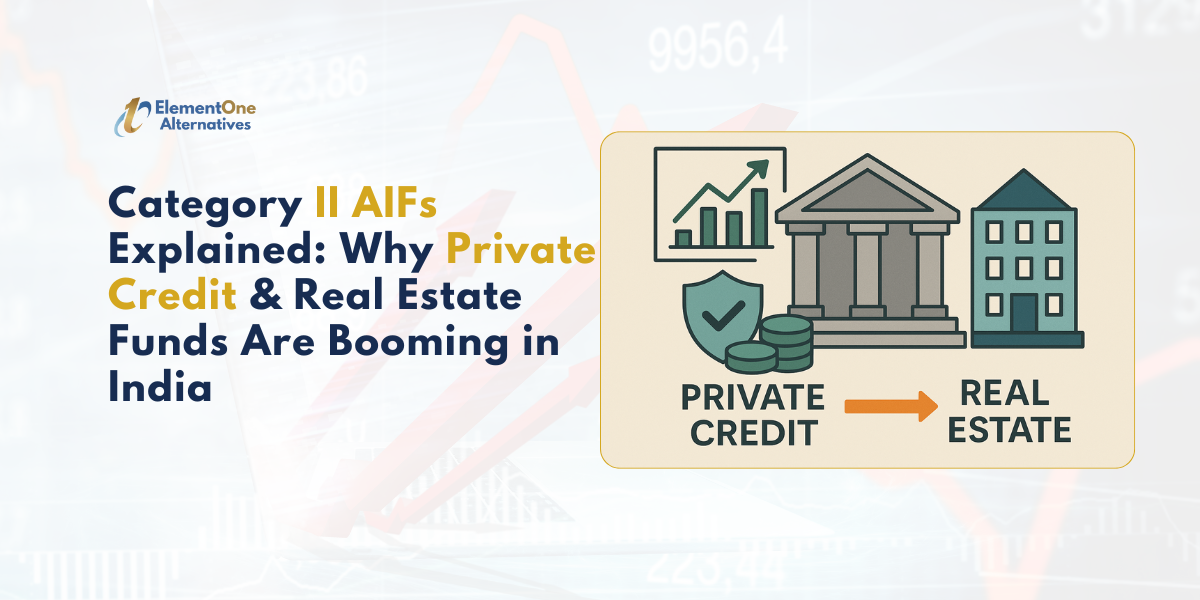
AIFs have quickly become the go-to investment vehicle for India’s wealthy. But within the AIF universe, Category II AIFs are seeing the largest money flow—from HNIs, UHNIs and Family Offices seeking higher return, secured, non-market-linked investments.
In our previous blog, we simplified AIFs for beginners and explained how they are different from traditional investments.
👉 Read Blog : What Are AIFs? A Beginner’s Guide for HNIs & Family Offices
Now, let’s go deeper into the most popular category—Category II AIFs, especially Private Credit and Real Estate funds, which are rapidly replacing traditional fixed-income products like FDs, bonds and NCDs in sophisticated portfolios.
What Are Category II AIFs?
SEBI classifies AIFs into 3 categories.
Category II is the largest, safest and fastest-growing segment.
Category II AIFs invest in private, structured opportunities such as:
✅ Private Credit
✅ Real Estate lending or participation
✅ Private Equity
✅ Structured debt / Mezzanine financing
✅ Distressed or special situations
✅ Fund-of-Funds investing in multiple AIFs
These investments are not publicly traded, so they don’t fluctuate with the stock market.
Returns are contractual in many cases, making them ideal for conservative and income-focused investors.
Why Category II AIFs Have Grown So Fast in India
1 Declining Confidence in Traditional Fixed Income
FD returns have dropped to 5%–7%.
Most corporate bonds are unsecured.
Government bonds protect capital, but offer low returns.
HNIs want higher yields without taking equity risk—that’s exactly what Category II AIFs offer.
-
Private Credit AIF returns: 11%–16%
-
Real Estate AIF returns: 12%–18%
-
Structured credit AIFs: 14%–20% in certain cases
This gap between “traditional returns” and “AIF returns” is driving capital inflow.
2 Asset-Backed Safety & Security
Unlike unsecured bonds or market-linked mutual funds, Category II AIF deals often have:
✔ Real estate collateral
✔ Land or building mortgage
✔ Cashflow escrow
✔ Personal guarantees from promoters
✔ Share pledging
✔ Senior-secured debt position
If a borrower fails to pay, the fund has legal rights on assets.
This reduces downside risk significantly.
3 Predictable Cashflows
Traditional equity has no payout certainty.
FDs pay quarterly or annually but with low yield.
Category II AIFs—especially Private Credit—offer:
-
Monthly payouts
-
Quarterly distributions
-
Fixed maturity (1–4 years)
-
Contractual interest
For wealthy families who need consistent income (to fund expenses, operations, philanthropy, salaries, or treasury requirements), predictable cashflow is a huge advantage.
4 Not Affected by Stock Market Volatility
Category II AIFs do not depend on:
❌ Stock markets
❌ Nifty / Sensex movement
❌ Global market sentiment
Even if markets crash, Private Credit borrowers are still legally bound to pay interest.
This makes Category II AIFs a low-volatility anchor inside portfolios.
5 Professional Due Diligence & Monitoring
Before investing, fund managers evaluate:
-
Company financials
-
Promoter background
-
Assets owned
-
Business cashflows
-
Debt repayment capability
-
Legal checks and credit underwriting
Once the deal is executed, funds actively monitor:
✅ Bank statements
✅ Cashflow control
✅ Asset valuation
✅ Business milestones
Individual investors cannot do this level of monitoring, which is why AIFs are preferred.
Segments Inside Category II AIFs
Let’s break them down clearly.
1 Private Credit AIFs (Fastest Growing)
These funds lend money to mid-sized, creditworthy businesses that need capital for:
-
Expansion
-
Working capital
-
Inventory
-
Projects
-
Acquisitions
-
Bridge finance
Why companies prefer Private Credit?
Banks are conservative and slow.
Private Credit offers faster capital with structured terms.
Why investors like Private Credit?
✅ Collateral-backed lending
✅ Contractual interest
✅ Fixed cashflows
✅ Short maturity (1–4 years)
✅ Low volatility
Typical yield: 11%–15% per annum
Payouts: Monthly or quarterly
Many HNIs now use Private Credit AIFs as a replacement for FDs and unsecured bonds.
2 Real Estate AIFs
These funds finance developers or builders—mostly in mid-income housing, commercial property, or last-mile completion projects.
AIFs earn higher yields because:
✅ Real estate asset is pledged
✅ Money is deployed late-stage, not at land acquisition
✅ Funds control project cashflows
✅ Promoters invest their own capital first
Typical yield: 12%–18% per annum
Risk level: Low to moderate
Why safer: physical collateral + strong legal rights
3 Private Equity / Growth Capital Funds
These funds invest in established businesses with strong growth potential.
Returns are generated through:
-
Business expansion
-
Profitability improvement
-
Company valuation increase
-
Strategic exit or acquisition
Tenure is longer, 5–7 years, but return potential is higher.
4 Special Situation & Structured Credit
These funds invest in:
-
Distressed but viable companies
-
Turnaround opportunities
-
Companies needing restructuring capital
They take asset-backed positions and generate strong yields.
5 Fund-of-Funds (FoF)
Instead of investing in a single fund, FoF invests in multiple AIFs, giving investors:
✔ diversification
✔ lower risk
✔ multi-strategy exposure
FoF is ideal for investors who don’t want to depend on just one asset or sector.
Category II AIFs vs Other Investments (Clear Comparison)
| Feature | Fixed Deposit | Bonds | Private Credit AIF | Real Estate AIF |
|---|---|---|---|---|
| Return | 5–7% | 7–9% | 11–15% | 12–18% |
| Market Linked | No | Sometimes | No | No |
| Collateral | No | Mostly No | Yes | Yes |
| Payout | Quarterly/Yearly | Annual | Monthly/Quarterly | Monthly/Quarterly |
| Risk Level | Very Low | Low–Medium | Low–Medium | Medium |
| Suitable For | Safety | Conservative | Income seekers | High yield + asset safety |
This is why wealthy Indian families are shifting their fixed-income allocation toward Category II AIFs.
Who Should Invest?
Category II AIFs are ideal for:
✔ HNIs
✔ UHNIs
✔ Family Offices
✔ Corporate treasuries
✔ Institutional investors
✔ Anyone who wants fixed, predictable income
Minimum investment: ₹1 crore (SEBI regulation)
Risks & Reality Check
No investment is risk-free.
Risks include:
-
Borrower default
-
Real estate project delays
-
Liquidity constraints (cannot exit anytime)
-
Macroeconomic slowdown
However, these risks are mitigated through:
✅ Collateral
✅ Cashflow escrow
✅ Promoter guarantees
✅ Legal enforcement
✅ Personal underwriting
✅ Conservative loan-to-value ratios
This makes Private Credit and Real Estate AIFs safer than unsecured corporate bonds or volatile equities.
Why Category II AIFs Work So Well in India
-
India’s mid-market businesses need capital
-
Banks have strict lending norms
-
Developers need flexible financing
-
Private wealth in India is rising
-
Investors are demanding inflation-beating income
-
SEBI regulates the entire AIF ecosystem
In short:
✔ Huge demand for capital
✔ High-quality borrowers
✔ Strong protection
✔ High yield for investors
It’s a win–win model.
Conclusion
Category II AIFs have become the backbone of modern wealth portfolios for HNIs and Family Offices.
They deliver:
✅ Higher returns than traditional debt
✅ Asset-backed security
✅ Predictable cashflows
✅ Lower volatility
✅ Expert underwriting
This is why Private Credit and Real Estate funds inside Category II AIFs are growing faster than any other investment category in India.
Keep reading and supporting ElementOne Alternatives!
Disclaimer: This information is provided solely for informational purposes and has been gathered from various online sources. ElementOne does not endorse or recommend any products or services. Please verify all details before making any decisions.