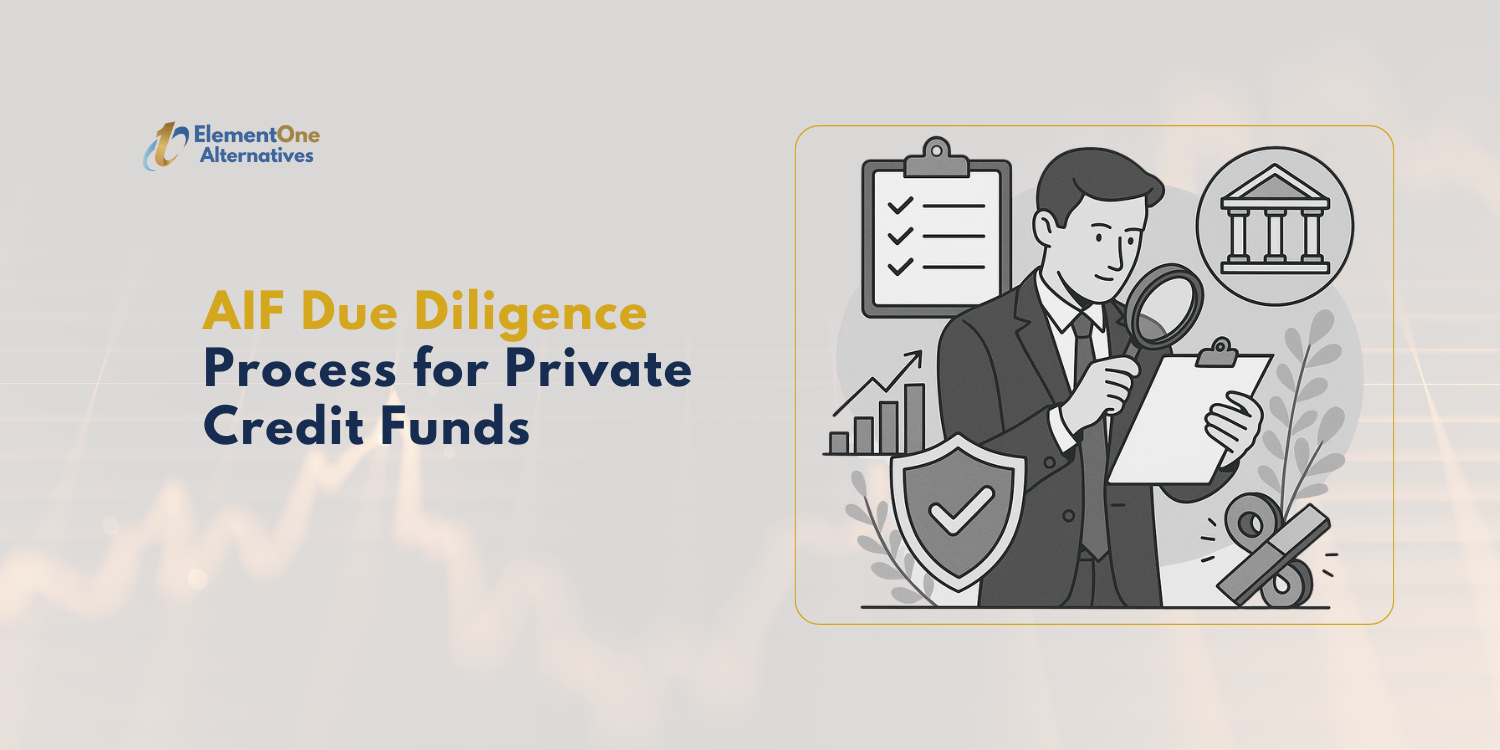
efore deploying even ₹1 of investor capital, a Category II AIF—especially one operating in Private Credit—conducts an intense, multi-layered evaluation to ensure the transaction is safe, feasible, and legally enforceable. This rigorous framework is known as the AIF Due Diligence Process, and it is the backbone of high-yield, low-volatility private credit investing.
While investors see the attractive benefits—11–16% yield, collateral-backed safety, monthly/quarterly payouts, and predictable cashflows—the real security comes from what happens before the deal is signed.
In our previous blog, we covered how investors should understand the risk and reward balance in Private Credit.
👉 Read Blog : Risk & Returns in Private Credit — What Investors Should Know
Now, let’s decode exactly how AIF fund managers perform due diligence to ensure capital protection and stable returns.
What Is the AIF Due Diligence Process?
The AIF Due Diligence Process is a comprehensive assessment conducted by fund managers to evaluate:
-
The borrower
-
The promoter
-
The business model
-
The financial stability
-
The collateral
-
The legal enforceability
-
The operational risks
-
The repayment capacity
This process determines:
✔ Whether to lend
✔ How much to lend
✔ At what interest rate
✔ What collateral to take
✔ What legal protections to enforce
✔ What covenants to impose
Private Credit is not unsecured lending.
It is structured, secured, and legally protected lending — made safe by due diligence.
Stages of AIF Due Diligence
Private Credit AIF due diligence can be broken into five core pillars:
-
Business Due Diligence
-
Financial Due Diligence
-
Collateral & Asset Due Diligence
-
Legal Due Diligence
-
Operational & Compliance Due Diligence
Let’s break each one down in detail.
1 Business Due Diligence: Understanding the Borrower
This is the foundation. AIFs evaluate:
✔ Business Model Strength
-
What does the company do?
-
Is the model stable or cyclical?
-
Is demand consistent or seasonal?
Private Credit prefers businesses with:
✔ Recurring revenue
✔ Predictable demand
✔ Low cyclicality
✔ Strong customer relationships
✔ Promoter Background & Integrity
AIFs perform:
-
Litigation search
-
Background checks
-
Reference checks
-
Past credit history
-
Net worth analysis
-
Fraud or default history
Promoter quality often decides repayment quality.
✔ Business Longevity & Growth
Is the company:
-
Early stage
-
Growth stage
-
Mature
-
Declining
Private Credit prefers companies that are stable, not speculative.
✔ Revenue Diversification
If one client contributes 80% of revenue → high risk.
A well-diversified client base reduces concentration risk.
✔ Supply Chain & Vendor Stability
Healthy vendor relationships ensure smooth operations.
2 Financial Due Diligence: Deep Analysis of Numbers
This is the heart of the AIF Due Diligence Process.
✔ Profit & Loss Statement Evaluation
Looking for:
-
Consistent revenue
-
Steady margins
-
Expense discipline
-
Growing profitability
Erratic P&L = higher risk.
✔ Balance Sheet Assessment
Focus on:
-
Debt-to-equity ratio
-
Short-term vs long-term liabilities
-
Assets owned
-
Current ratio
-
Inventory movement
Financial strength = repayment strength.
✔ Cashflow Analysis (MOST IMPORTANT)
Private Credit is repaid through cashflows, not valuation.
AIFs evaluate:
-
Operating cashflow
-
Cash conversion cycle
-
Working capital requirement
-
Cashflow seasonality
-
Cash buffer
✔ Debt Servicing Capacity
Key metric: DSCR (Debt Service Coverage Ratio)
DSCR > 1.3 is considered good.
✔ Bank Statement Verification
Validates actual cash inflow/outflow — eliminating risk of inflated financials.
3 Collateral & Asset Due Diligence: Ensuring Security
Collateral is the biggest reason Private Credit is safer than unsecured bonds.
✔ Independent Valuation
Third-party valuers verify market value.
✔ Conservative LTV (Loan-to-Value) Ratios
Most AIFs lend at 60–75% LTV, ensuring:
-
Asset value > loan amount
-
Downside protection
✔ Collateral Quality Check
Collateral may include:
-
Real estate
-
Machinery
-
Inventory
-
Receivables
-
Equity or share pledge
-
Warehouse assets
-
Land parcels
✔ Liquidation Potential
If borrower defaults, how fast can collateral be sold?
Real estate in prime locations is safer than assets in remote areas.
✔ Encumbrance Check
Ensures asset is not already pledged to another lender.
4 Legal Due Diligence: Making the Deal Enforceable
Legal DD ensures the contract protects the investor.
✔ Verification of Title Documents
Especially critical for real estate.
✔ Registration of Charge
Fund records legal charge via:
-
ROC
-
CERSAI
-
Stamp duty
-
RERA (if applicable)
This ensures first right of recovery.
✔ Drafting of Contracts & Agreements
Includes:
-
Loan agreement
-
Security documents
-
Escrow agreement
-
Guarantee documentation
-
Hypothecation deed
-
Share pledge agreement
✔ Guarantee Enforcement
Personal and corporate guarantees increase accountability.
✔ Covenant Structuring
Borrower must meet specific conditions like:
-
Maintain financial ratios
-
Restriction on taking new loans
-
Mandatory reporting
If borrower violates, lender gets immediate rights to act.
5 Operational & Compliance Due Diligence
This step checks internal processes of borrower:
✔ KYC / AML Checks
Ensures no criminal or fraudulent background.
✔ GST / Tax Compliance
Red flags include:
-
GST mismatch
-
Delayed filings
-
Tax notices
✔ Auditor Quality
Credible auditors → reliable financial statements.
✔ Governance Standards
Strong governance reduces fraud risk.
Ongoing Monitoring (Post-Investment Due Diligence)
The AIF Due Diligence Process doesn’t end after investment.
Fund managers track:
-
Monthly bank statements
-
Sales reports
-
Inventory movement
-
Collection efficiency
-
Project progress (real estate)
-
Cashflow escrow
-
Covenant compliance
If early warning signals appear, fund managers take proactive action.
How Due Diligence Reduces Risk for Investors
✔ Ensures only strong companies get funding
✔ Protects capital through collateral
✔ Avoids fraud or misreporting
✔ Creates rights to recover capital
✔ Reduces default probability
✔ Maintains predictable returns
Due diligence is why Private Credit has one of the lowest loss rates among alternative investments globally.
Why AIF Due Diligence Process Is Better Than:
❌ Retail direct lending
→ No monitoring, no collateral enforcement
❌ Unsecured corporate bonds
→ No asset backing, rating downgrades wipe value
❌ Equity
→ Market-linked volatility, no guaranteed income
❌ Startups
→ High failure rate
AIF due diligence provides:
✔ institutional grade analysis
✔ structured security
✔ legal control
✔ consistent cashflows
That’s why Private Credit AIFs attract large capital from HNIs, Family Offices and Corporates.
Conclusion
The AIF Due Diligence Process is the invisible engine behind the safety and stability of Private Credit.
It ensures:
-
Careful borrower selection
-
Accurate financial analysis
-
High-quality collateral
-
Strong legal frameworks
-
Ongoing monitoring
This is what allows investors to earn high, predictable, inflation-beating returns while keeping downside risk controlled.
Private Credit is not just high yield — it is high yield + high structure + high security, and due diligence is what makes this possible.
Keep reading and supporting ElementOne Alternatives!
Disclaimer: This information is provided solely for informational purposes and has been gathered from various online sources. ElementOne does not endorse or recommend any products or services. Please verify all details before making any decisions.