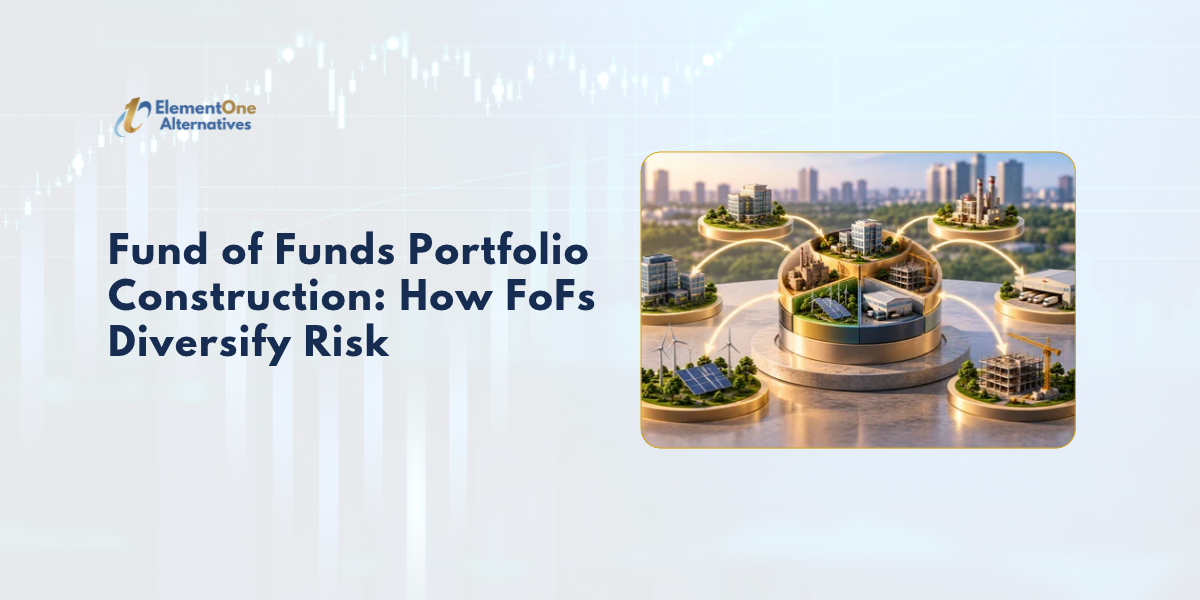

How does fund of funds work in India? In simple terms, a Fund of Funds (FoF) is an investment vehicle that does not invest directly in companies, loans or securities. Instead, it pools capital from investors and invests it in a portfolio of other funds. The investor gets exposure to several underlying funds and managers through a single commitment, with the FoF manager responsible for selecting, allocating and monitoring those funds.
This guide explains how a Fund of Funds works in India, the five steps of its lifecycle, how it differs from investing in a single fund, what the trade-offs are, and what HNIs should evaluate before investing.
What Is a Fund of Funds?
A Fund of Funds is a pooled investment structure whose underlying investments are units of other funds. In the Indian AIF landscape, a Category II Fund of Funds typically invests in other Alternative Investment Funds, such as private credit funds or private equity funds, rather than lending to businesses or buying stakes in them directly.
The underlying funds each have their own managers, strategies and portfolios. The FoF sits one level above them, deciding which funds to back, how much to allocate to each and when to add or reduce exposure.
To understand the underlying building blocks, you can start with our guides: What is private credit AIF and Category II AIFs.
How Does Fund of Funds Work? The 5-Step Process
Step 1: The FoF Raises Capital from Eligible Investors
Like other AIFs, a Fund of Funds raises money from eligible investors such as HNIs, UHNIs, family offices and institutions, subject to SEBI’s minimum investment requirement. The terms of the fund, including its strategy, tenure, fees and risks, are disclosed in the Private Placement Memorandum (PPM). Capital is commonly called in stages through drawdowns rather than all at once.
Step 2: The Manager Sources and Screens Underlying Funds
The FoF manager builds a universe of potential underlying funds. This involves reviewing each fund’s strategy, track record, team, origination process, risk controls and reporting quality. A good manager screens widely but selects narrowly, since the quality of the FoF depends on the quality of the funds it backs.
Step 3: The Manager Conducts Due Diligence
Selection goes beyond performance numbers. Due diligence typically covers the underlying manager’s experience, the loan or investment pipeline, portfolio concentration, security structures, valuation practices, fee terms and how the manager has handled stressed investments.
Step 4: The Manager Allocates and Diversifies
Once funds are shortlisted, the manager decides how much to allocate to each. The aim is to spread exposure across managers, strategies, sectors and, where relevant, vintages, so that no single underlying fund or borrower type dominates the outcome. This diversification is the central reason investors consider a Fund of Funds.
Step 5: The Manager Monitors and Distributes
After investing, the FoF manager tracks the performance of each underlying fund through periodic reporting, valuation updates and discussions with the underlying managers. As the underlying funds distribute proceeds from interest, repayments or exits, cash flows to the FoF and, after expenses and fees, to the FoF’s investors according to the PPM. Timing depends on the cash flow pattern of the underlying funds.
How Does Fund of Funds Work Compared with a Single AIF?
| Parameter | Fund of Funds | Single AIF |
|---|---|---|
| Exposure | Multiple underlying funds and managers | One fund with one manager’s strategy |
| Diversification | Spread across funds, strategies and borrowers | Depends on that one fund’s portfolio |
| Manager Selection | Handled by the FoF manager | Investor selects and evaluates the fund |
| Fee Layers | Fees at the FoF level and within underlying funds | Fees at one level |
| Liquidity | Generally closed-ended, linked to underlying fund timelines | Generally closed-ended with its own tenure |
| Transparency | Requires look-through into underlying funds | Direct view of one portfolio |
Benefits of a Fund of Funds Structure
Built-In Diversification
A single commitment gives exposure to several funds and, through them, to many borrowers or investments. This reduces dependence on any one manager’s decisions.
Professional Manager Selection
Identifying strong private fund managers takes time, access and expertise. A FoF manager takes on that research and monitoring on the investor’s behalf.
Access to a Broader Set of Managers
Some underlying funds are difficult for individual investors to reach or evaluate. A FoF can provide access through an institutional relationship and a structured selection process.
Simplified Administration
Investors deal with one fund, one set of documents and one reporting stream instead of managing multiple commitments separately.
What HNIs Should Evaluate Before Investing
Useful questions include: How many underlying funds does the FoF hold, and how are they selected? How is exposure spread across managers, sectors and vintages? What are the total fees, including at the underlying fund level? What is the fund’s tenure and how do distributions flow through? How does the manager monitor underlying funds and what look-through reporting is provided? How has the manager handled underperforming or stressed funds?
A manager who can answer these specifically, with examples, is usually a stronger signal than one who emphasises headline outcomes.
Regulatory Context
Fund of Funds structures offered as AIFs in India operate under SEBI’s Alternative Investment Funds Regulations, which cover registration, categorisation, disclosures, reporting and investor eligibility. The specific strategy, fees, tenure and risks of a fund are disclosed in its PPM, which investors should read carefully before committing capital.
You can review SEBI’s AIF regulatory framework on the official SEBI website.
Final Thoughts
So, how does fund of funds work in one line? It pools investor capital and invests it across a curated set of underlying funds, giving diversification and professional manager selection in exchange for layered fees and a longer, less liquid commitment.
For HNIs, a Fund of Funds can be a practical way to access private markets without evaluating each manager individually. The key is understanding the structure, the total cost and the manager behind it.
If you would like to see how a diversified private credit Fund of Funds can fit into your portfolio, Explore ElementOne’s private credit Fund of Funds. Explore ElementOne private credit Fund of Funds.
Frequently Asked Questions
How does fund of funds work in India?
A Fund of Funds pools money from eligible investors and invests it in a portfolio of other funds instead of investing directly in companies or loans. The FoF manager selects the underlying funds, allocates capital, monitors performance and distributes proceeds to investors after expenses.
What is the difference between a Fund of Funds and a single AIF?
A single AIF invests directly in its own portfolio under one manager’s strategy. A Fund of Funds invests in several such funds, spreading exposure across managers and strategies, though investors may bear fees at more than one level.
Is a Fund of Funds safer than investing in one fund?
It can reduce dependence on any single manager or borrower through diversification, but it is not risk-free. Credit risk, liquidity risk and selection risk still apply, and returns are not guaranteed.
Does a Fund of Funds charge double fees?
Investors may bear fees at the FoF level as well as within the underlying funds. The total cost should be reviewed in the PPM and confirmed with the manager before investing.
Who can invest in a Fund of Funds AIF in India?
Eligible investors who meet SEBI’s requirements, including the minimum investment amount, can invest. HNIs, UHNIs, family offices and institutions commonly do.