
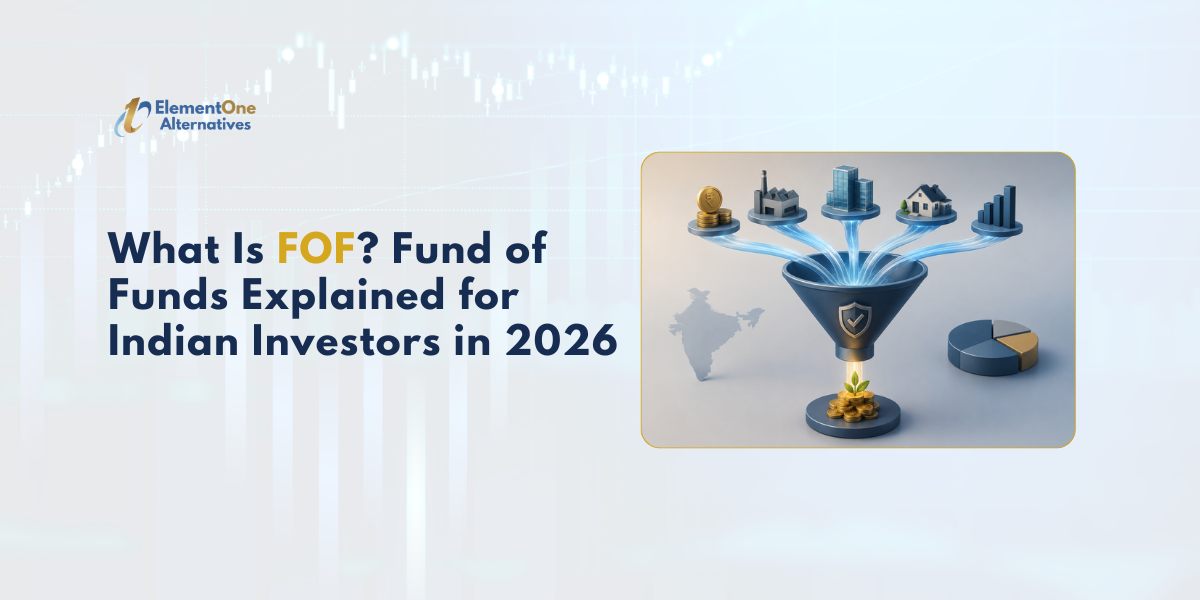
What is FOF — this three-letter acronym is showing up more frequently in Indian wealth management conversations, and for good reason. FOF stands for Fund of Funds, an investment structure that has quietly grown in popularity among HNIs who want exposure to Alternative Investment Funds without directly selecting and managing individual fund manager relationships.
This guide explains exactly what FOF means, how a fund of funds structure works in India, what the advantages and trade-offs are, and how to decide whether an FOF or a direct AIF investment is the right choice for your portfolio in 2026.
What Is FOF? A Simple Definition
FOF stands for Fund of Funds — an investment vehicle that does not invest directly in stocks, bonds, or private companies. Instead, an FOF invests in other funds, pooling investor capital and allocating it across multiple underlying Alternative Investment Funds, each managed by a different fund manager with a different strategy.
In India, an FOF is itself typically structured as a SEBI-registered AIF — most commonly under Category II — that in turn invests its corpus into a portfolio of other Category I, II, or III AIFs. When investors ask what is FOF in the context of Indian alternative investing, this two-layer structure is the defining characteristic.
To understand the underlying AIFs that an FOF invests into, read our guide. what is an Alternative Investment Fund.
How an FOF Works in Practice
Capital Raising
An FOF raises capital from HNI and institutional investors, just like any other AIF, subject to the same SEBI-mandated minimum investment of ₹1 crore. Investors commit capital to the FOF itself, not to the underlying funds directly.
Manager Selection
The FOF manager’s core job is manager selection — identifying, evaluating, and allocating capital across a curated set of underlying AIF managers across private credit, private equity, real estate debt, or venture capital strategies. This is fundamentally different from a direct AIF manager, whose job is deal origination and portfolio construction within a single strategy.
Capital Deployment Across Underlying Funds
Once capital is raised, the FOF manager deploys it across a portfolio of underlying AIFs — typically 5 to 15 different funds — diversifying across strategies, vintage years, and fund managers. This creates a layer of diversification that a single direct AIF investment cannot offer.
Reporting and Distributions
Investors in an FOF receive consolidated reporting on the overall FOF portfolio, rather than separate reports from each underlying fund. Distributions flow from the underlying AIFs to the FOF, and then from the FOF to investors — a structure that adds a layer between the investor and the source of returns.
What Is FOF: Key Advantages for Investors
Diversification Across Managers and Strategies
The most significant advantage of an FOF is diversification. Rather than committing ₹1 crore to a single private credit fund manager, an FOF investor gains exposure to multiple managers and potentially multiple strategies through a single commitment — reducing single-manager risk.
Access to Curated, Vetted Managers
A quality FOF manager conducts rigorous due diligence on underlying fund managers before allocating capital — providing investors with a layer of professional manager selection that individual HNIs may not have the time, expertise, or network to replicate on their own.
Simplified Administration
Rather than tracking capital calls, distributions, and reporting from multiple individual AIF investments, an FOF investor deals with a single relationship, single set of documentation, and consolidated reporting — a meaningful convenience for investors who do not want to manage multiple direct AIF relationships.
Lower Effective Minimum Per Underlying Fund
Since the FOF pools capital across many investors before allocating to underlying funds, an FOF investor with ₹1 crore effectively gains exposure to funds that might individually have required a larger commitment to access directly, or that might not have been accessible at all due to closed fundraising windows.
What Is FOF: Important Factors to Understand Before Investing
Fee Structure Across Two Layers
When evaluating what is FOF as an investment structure, it is important to understand that fees exist at two levels — the underlying AIF managers charge their standard management and performance fees, and the FOF manager charges an additional fee for manager selection and portfolio construction. Investors should review the complete fee structure across both layers, as this determines the net return after all costs.
Delegated Decision-Making
In an FOF structure, the FOF manager makes the decisions about which underlying funds to allocate to and how much. This delegated approach means investors benefit from the FOF manager’s expertise and due diligence, though it involves less direct, day-to-day visibility into each underlying fund manager compared to a direct AIF relationship.
Blended Portfolio Returns
Because an FOF diversifies capital across multiple managers, the overall portfolio return reflects a blend of underlying fund performance rather than the outcome of any single fund. This diversification reduces single-manager risk, though it also means the portfolio return sits closer to an average across the underlying funds rather than capturing the peak performance of any one top-performing manager.
What Is FOF vs Direct AIF Investment: A Direct Comparison
| Parameter | Fund of Funds (FOF) | Direct AIF Investment |
|---|---|---|
| Fees | Double layer — underlying fund fees plus FOF fee | Single layer — fund manager fee only |
| Diversification | High — across multiple managers and strategies | Concentrated — single manager and strategy |
| Control | Limited — FOF manager selects underlying funds | Full — investor selects specific fund |
| Due Diligence Required | Lower — FOF manager conducts underlying due diligence | Higher — investor must evaluate the fund manager directly |
| Return Potential | Averaged across underlying funds | Full upside of the selected manager’s performance |
| Minimum Investment | ₹1 crore (SEBI AIF minimum) | ₹1 crore (SEBI AIF minimum) |
For a deeper comparison, read our guide: How to invest in AIF in India.
Who Should Consider an FOF in India?
First-Time AIF Investors
For HNIs who are new to alternative investments and do not yet have the network or expertise to evaluate individual fund managers directly, an FOF provides a professionally curated entry point into the asset class — trading some fee efficiency for reduced due diligence burden.
Investors Seeking Broad Diversification
HNIs who want exposure across multiple AIF strategies — private credit, private equity, real estate debt — without committing separate ₹1 crore allocations to each may find an FOF structure more capital-efficient for achieving this diversification.
Investors Without Time for Ongoing Manager Monitoring
Direct AIF investing requires ongoing engagement — reviewing quarterly reports, monitoring manager performance, and staying informed about each fund’s portfolio. Investors who prefer a more passive, delegated approach may find the consolidated reporting of an FOF more manageable.
Who Should Prefer Direct AIF Investment Over an FOF?
HNIs who have the time, network, and expertise to evaluate fund managers directly, and who want to avoid the double fee layer, are generally better served by direct AIF investment. This is particularly true for investors who have identified a specific fund manager with a strong track record — such as a well-established Category II private credit fund — where the full return potential is preserved without FOF-level fee dilution.
For a detailed framework on evaluating and choosing a direct AIF, read our guide: Best AIF in India.
Verifying an FOF’s SEBI Registration
Like any AIF in India, an FOF must be SEBI-registered, typically under Category II, with a verifiable registration number in the format IN/AIF2/. Before investing in any FOF, verify this registration independently on the official SEBI website, and review the Private Placement Memorandum to understand exactly which underlying funds and strategies the FOF invests in, and what the complete fee structure looks like across both layers.
Final Thoughts
Understanding what is FOF gives HNIs an important additional option when building an alternative investment portfolio in India. A fund of funds offers genuine diversification and professional manager selection — valuable for investors newer to the asset class or seeking broad exposure without extensive direct due diligence. The trade-off is a double fee layer and reduced control that can meaningfully affect net returns compared to a well-chosen direct AIF investment.
For most experienced HNIs who have identified a credible, well-track-recorded fund manager, direct investment in a single Category II AIF — particularly private credit — often preserves more of the underlying return potential than an FOF structure.
If you are weighing an FOF against direct AIF investment and want to understand how a SEBI-registered Category II private credit fund compares, ElementOne Alternatives offers complete transparency on our strategy, fee structure, and track record. Reach out to our team.
Frequently Asked Questions
What is FOF in simple terms?
FOF stands for Fund of Funds — an investment vehicle that pools investor capital and allocates it across multiple underlying Alternative Investment Funds rather than investing directly in stocks, private companies, or loans. In India, FOFs are typically structured as Category II AIFs.
What is the minimum investment for an FOF in India?
Like all AIFs in India, an FOF requires a minimum investment of ₹1 crore per investor, as mandated by SEBI. This applies regardless of how many underlying funds the FOF ultimately allocates to.
Is FOF better than a direct AIF investment?
Neither is universally better. An FOF offers diversification and professional manager selection at the cost of a double fee layer. A direct AIF investment preserves more return potential but requires the investor to conduct their own manager due diligence. The right choice depends on the investor’s experience, network, and time availability.
What fees does an FOF charge in India?
FOF investors typically pay two layers of fees — the management and performance fees charged by each underlying AIF manager, plus an additional fee charged by the FOF manager for manager selection and portfolio construction. This double fee layer is the most important consideration when evaluating an FOF.
How do I verify if an FOF is SEBI registered in India?
Verify the FOF’s SEBI registration on the official SEBI website — legitimate FOFs will have a registration number typically in the format IN/AIF2/. Always review the Private Placement Memorandum to understand which underlying funds the FOF invests in. For a broader guide on AIF due diligence, read: Best AIF in India.